
Sometimes the fastest way to understand a rule is to see it applied to real dates. Here's a set of worked examples across different months, including a few tricky edge cases, so you can sanity-check your own calculation against something concrete.
Quick reference table
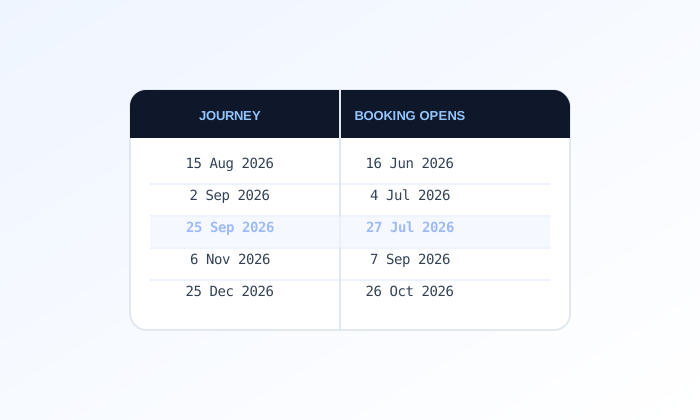
| Journey date | Booking opens | Day of week |
|---|---|---|
| 15 August 2026 | 16 June 2026 | Tuesday |
| 2 September 2026 | 4 July 2026 | Saturday |
| 25 September 2026 | 27 July 2026 | Monday |
| 2 October 2026 | 3 August 2026 | Monday |
| 6 November 2026 | 7 September 2026 | Monday |
| 25 December 2026 | 26 October 2026 | Monday |
| 1 January 2027 | 2 November 2026 | Monday |
| 14 February 2027 | 16 December 2026 | Wednesday |
These dates assume the current 60-day General quota rule
If Indian Railways changes the Advance Reservation Period again in the future, these specific examples would need to be recalculated. Use our live calculator for guaranteed up-to-date results.
Worked example: New Year travel
Journey date: 1 January 2027
Booking opens: 2 November 2026, at 8:00 AM IST
This crosses from November into January — three different months — which is exactly the kind of span where manual counting is most error-prone. A calculator handles this instantly regardless of how many months the window spans.
Worked example: Diwali travel
Journey date: 6 November 2026
Booking opens: 7 September 2026, at 8:00 AM IST
Given how quickly festival routes fill up, this is a date worth calculating the moment your travel plans are fixed — see our festival booking guide for the full strategy.
Worked example: short-notice travel
If today is 20 July 2026 and you need to travel on 30 July 2026, your journey is only 10 days away. The General quota window for this journey opened around 31 May 2026 — nearly two months ago. At this point, your realistic options are checking current waiting list availability or considering Tatkal booking one day before travel.
Worked example: a leap year edge case
Journey date: 25 March 2028
2028 is a leap year, meaning February has 29 days instead of 28. Counting 60 days back from 25 March 2028 needs to account for that extra day — landing on 25 January 2028 rather than 26 January, which is where a non-leap-year calculation would incorrectly land.
How to use this page
Treat this as a sanity check, not your primary calculation method — your exact journey date almost certainly isn't one of the examples listed above. For your specific date, use the homepage calculator, which performs the same precise calendar arithmetic shown in these examples, instantly and for any date you enter.
Common mistakes when using example tables like this
- Assuming a nearby example date applies directly to your own, slightly different journey date.
- Not accounting for leap years when adapting an example to a different year.
- Forgetting these examples apply to General quota only, not Tatkal.
- Using an old or outdated example table if the underlying 60-day rule has changed since it was published.
Quick summary
- Booking opens 60 days before your journey date under the General quota, at 8:00 AM.
- Tatkal and Premium Tatkal open one day before travel, with separate timings for AC and Non-AC classes.
- Rules can change — always confirm close to your travel date on the official IRCTC platform.
Frequently Asked Questions
Know your exact booking date
Enter your journey date and get the precise Advance Reservation Period opening — in under 3 seconds.
Calculate Your Booking Date