Most IRCTC frustration isn't about the booking rules themselves — it's about small account and app setup details that make the actual booking moment smoother or rockier. Here are the ones worth fixing before your next booking day, not during it.
1. Keep your master passenger list updated
IRCTC lets you save frequent passengers' details so you don't retype them every time. Review this list periodically — remove outdated entries, add new family members, and double check ages are current, since age affects berth allocation and concessions in some cases.
2. Verify your payment methods well in advance
Don't wait until a high-demand booking morning to discover your saved card has expired or your UPI app needs re-verification. Do a small test booking or check your payment methods' status a few days ahead of any date that matters.
Have a backup payment method ready
If your primary payment method fails mid-booking during a high-demand window, having a second verified option ready (a different UPI app or card) can save the booking rather than losing it entirely to a payment retry.
3. Use the official IRCTC app over browser booking when possible
The dedicated app is often more stable during high-traffic periods than a mobile browser, and tends to have a more streamlined booking flow. If you regularly book on high-demand routes, it's worth having the app installed and updated rather than relying on a browser tab.
4. Double-check train number and boarding station before submitting
Especially when booking quickly during a rush, it's easy to select the wrong train number or an unintended boarding station. A five-second check before hitting submit avoids a booking mistake that's often costly or impossible to fix afterward.
Before clicking "book now," confirm: correct journey date, correct train number, correct class, correct boarding station, and passenger details all accurate. Takes seconds, saves real headaches.
5. Understand your account's booking limits
IRCTC accounts have limits on how many tickets can be booked within certain time periods, partly to prevent bulk or bot-like booking behaviour. If you're booking frequently for a large family or group, it's worth understanding these limits so you're not caught off guard mid-season.
6. Keep your KYC and profile details current
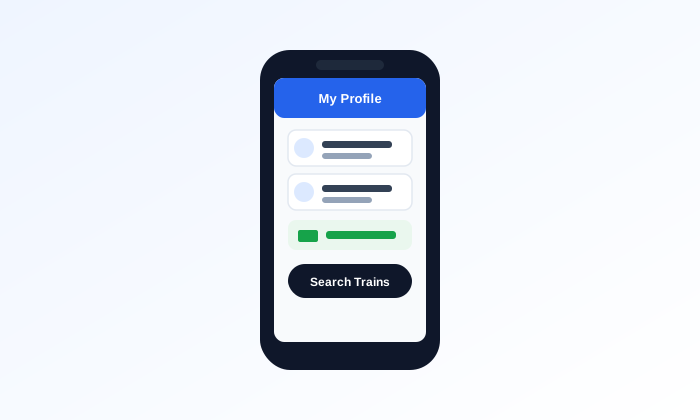
IRCTC periodically requires profile verification or KYC updates. Letting this lapse can create friction exactly when you don't want it — right before a high-demand booking. Check your account status occasionally, not just when a problem pops up.
7. Bookmark or save this site's calculator for quick access
Rather than mentally counting 60 days each time, bookmark the booking date calculator so it's one tap away whenever a new travel plan comes up. Small friction reductions like this add up over a year of regular travel.
8. Know the cancellation and refund process before you need it
Plans change. Understanding how to cancel a ticket and what refund to expect — before you're in a rush to do it — means you won't be learning the process for the first time under pressure.
Rules can vary by ticket type
Cancellation charges and refund timelines differ between confirmed, RAC, and waiting list tickets, and can change over time. Always check the current specific rule on IRCTC rather than assuming it matches what you remember from a previous booking.
9. Set up account recovery details properly
Make sure your registered email and phone number on IRCTC are current and accessible, so you're never locked out of your account right when you need to book or manage a ticket.
10. Familiarize yourself with the app before a high-stakes booking day
If IRCTC has updated its app or website interface recently, spend a few minutes exploring it calmly beforehand rather than encountering unfamiliar screens for the first time during a booking rush.
11. Use saved searches or recent trains if available
Many booking flows let you quickly access recently searched trains or routes. If you're booking the same route repeatedly (say, a regular commute home), this can shave valuable seconds off your booking process.
12. Keep a note of your PNR after booking
Save your PNR number somewhere easy to find — a notes app, a screenshot, an email confirmation — so checking your ticket status or chart preparation result later doesn't require digging through old messages.
What to avoid
- Waiting until booking day to update passenger details or payment methods.
- Not knowing your account's booking limits until you hit them.
- Letting KYC or profile verification lapse unnoticed.
- Learning the cancellation process for the first time under time pressure.
Quick summary
- Booking opens 60 days before your journey date under the General quota, at 8:00 AM.
- Tatkal and Premium Tatkal open one day before travel, with separate timings for AC and Non-AC classes.
- Rules can change — always confirm close to your travel date on the official IRCTC platform.
Frequently Asked Questions
Know your exact booking date
Enter your journey date and get the precise Advance Reservation Period opening — in under 3 seconds.
Calculate Your Booking Date